Carpet Area Meaning: Carpet vs Built-up vs Super Built-up
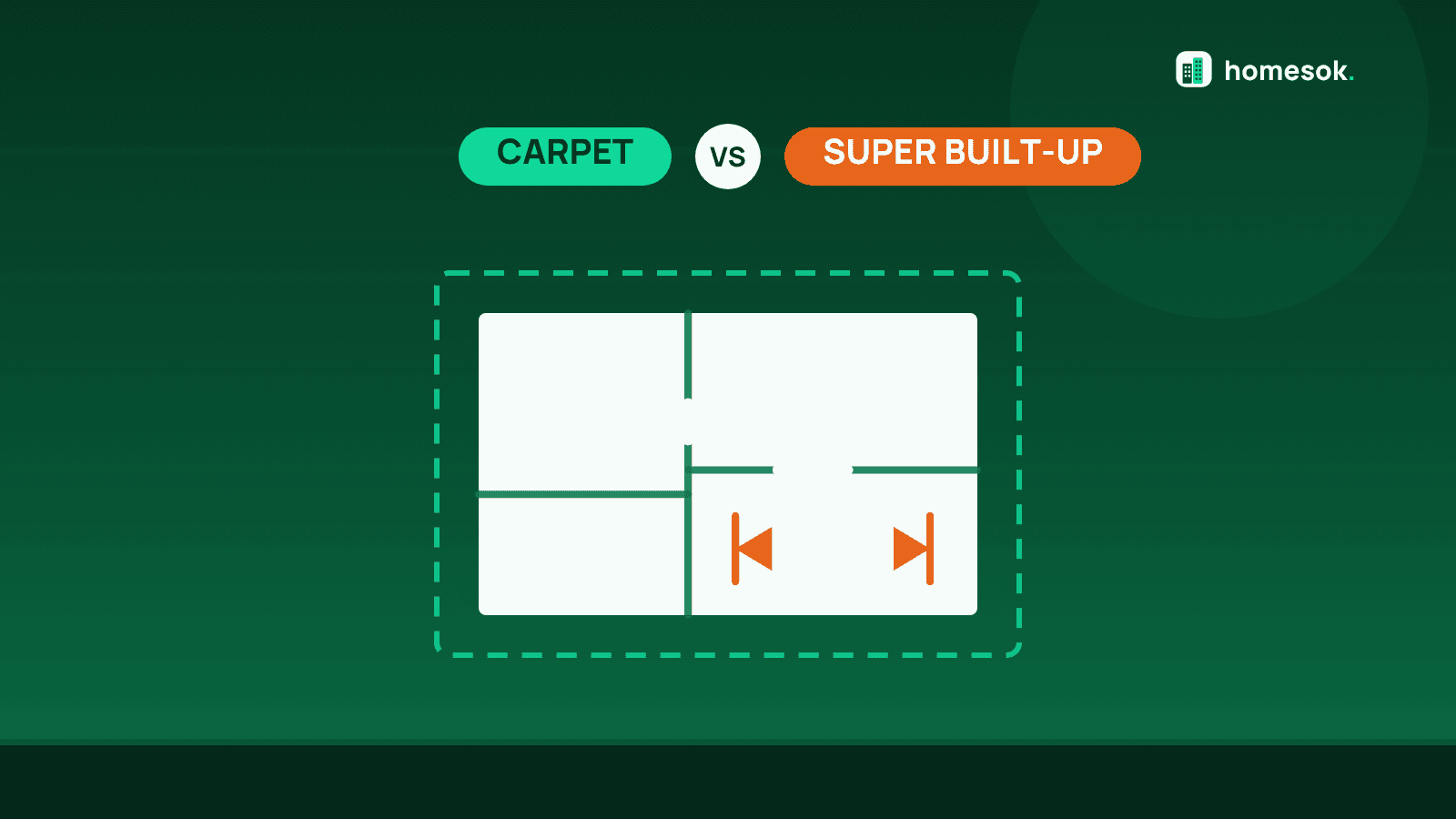
Carpet area is the net usable floor area of a flat, defined by Section 2(k) of the RERA Act: internal partition walls count, external walls, shafts, exclusive balconies and terraces do not. Built-up and super built-up have no statutory definition. Across ten Bangalore apartment projects surveyed in this guide, carpet area runs 56% to 72% of super built-up, and any shortfall at handover is refundable within 60 days with interest.
Carpet area is the floor space you can actually use inside your flat: every room measured wall to wall, including the internal walls between rooms, but not your balcony. Built-up area adds the thickness of the walls and the balcony, so the same flat measures larger on paper. Super built-up area adds your share of the building's common spaces on top: lobby, corridors, staircases, clubhouse. A flat sold as 1,500 sq ft super built-up is typically about 900 sq ft of carpet in Bangalore today. Only one of the three, carpet area, is defined by law, and it is the number every RERA disclosure, agreement and refund calculation runs on.
One flat, three boundaries: carpet is the room space you use, internal walls included; built-up adds the external walls and balcony; super built-up adds your share of the common areas.
Carpet area meaning under RERA
Section 2(k) of the Real Estate (Regulation and Development) Act, 2016 defines carpet area as 'the net usable floor area of an apartment, excluding the area covered by the external walls, areas under services shafts, exclusive balcony or verandah area and exclusive open terrace area, but includes the area covered by the internal partition walls of the apartment.'
Two details in that definition surprise people:
- Internal partition walls count as carpet area. The wall between your bedrooms is inside the number.
- Your balcony does not count, even though it is exclusively yours. The Act's explanation defines exclusive balcony, verandah and open terrace areas separately, and RERA requires them to be disclosed separately.
So RERA carpet area is not 'where a carpet can lie'; it is usable floor plus internal walls, minus external walls, shafts, balconies and terraces.
What RERA counts in carpet area, and what it leaves out (Section 2(k), RERA Act 2016).
Two different carpet areas exist in Indian law. The National Building Code 2016 (Part 3, clause 2.15) defines carpet area as the covered area of usable rooms 'excluding the area of the wall', while RERA includes internal partition walls. The same flat therefore has a slightly larger RERA carpet area than its building-code carpet area. When comparing projects, make sure both numbers are RERA carpet areas.
Built-up and super built-up: industry terms, not legal ones
Built-up area is commonly described as carpet plus wall thickness plus balcony. No sale statute defines it; the closest legal concept is the building code's plinth area (NBC 2016, clause 2.66), and measurement of these areas is standardised by BIS standard IS 3861:2002, not by RERA.
Super built-up area is carpet plus a proportionate share of common areas. It appears nowhere in the RERA Act and nowhere in the National Building Code; we ran full-text searches of both to be sure. It is a marketing convention, which is exactly why the law stepped in with mandatory carpet-area disclosure.
Loading: why the gap exists and how to compute it
The difference between super built-up and carpet is the loading: the share of what you pay for that is not inside your front door. It exists because a building is more than its flats. Corridors, lift lobbies, staircases and amenities have to be built and paid for, and developers recover that cost by spreading it across units as loading. The problem is not that loading exists; it is that no law caps it, and for years flats were priced on the loaded number with the usable number nowhere in the paperwork.
The cleanest way to express loading is the carpet share: RERA carpet area divided by super built-up area. ANAROCK research reported in June 2025 put the top-7-city average around 40% loading (buyers get roughly 60% of the paid-for area as carpet), with Bengaluru around 41%, up from about 30% in 2019.
The same flat, two honest numbers: at the reported average share, 1,500 sq ft super built-up is about 900 sq ft of carpet; the other 600 sq ft is walls, balcony and common share.
To estimate carpet from a super built-up quote: carpet area = super built-up x carpet share. At Bengaluru's reported average of roughly 60%, a 1,500 sq ft super built-up flat is about 900 sq ft of carpet. Going the other way, loading as builders quote it = (super built-up / carpet) minus 1; the same 1,500/900 flat carries 67% loading by that convention and 40% by the share convention. Always ask which formula a quoted percentage uses; the two conventions are the single biggest source of confusion in area maths.
You should never need to estimate for a RERA-registered project, though. The registered carpet area of every unit type is public on the K-RERA project page (rera.karnataka.gov.in), and the mandatory agreement quotes your price on it. Ask for the number; if the seller cannot produce it, that tells you something about the project.
What RERA makes builders do
RERA did not ban the phrase super built-up. What it did is make carpet area the mandatory basis of the transaction:
- The project's registration must state the carpet area of every apartment type, with exclusive balcony and terrace areas shown separately (Section 4(2)(h)), and that inventory is public on the K-RERA website (Section 11).
- The agreement for sale that Karnataka made mandatory in June 2020 (Rule 8A, Annexure-A) prices the flat on carpet area: clause 1.2 states the total price 'based on the carpet area'.
- For ongoing projects, Karnataka's Rule 4(3) required promoters to re-disclose sizes on carpet area even if units were earlier sold on super built-up.
- Contraventions expose the promoter to penalties of up to 5% of the estimated project cost (Sections 60 and 61).
The 3% rule: what it actually says
Almost every article says 'RERA allows a 3% variation in carpet area'. The Act says no such thing; the phrase 'three per cent' does not appear anywhere in it, and Section 14(3), which articles routinely cite for it, is actually the five-year defect-liability clause. The 3% mechanics live in the mandatory agreement for sale. Clause 1.7 of Karnataka's Annexure-A proforma says, in plain terms:
- After the occupancy certificate, the promoter must confirm the final carpet area of your flat, with details of changes.
- If the delivered area is smaller by any amount, even one square foot, the promoter must refund the excess at the same per-sq-ft rate as your agreement, within 60 days, with annual interest at SBI's highest MCLR plus 2% (Karnataka Rule 16), counted from the date you paid the excess.
- If the delivered area is larger, the promoter may charge you only for an increase of up to 3%, at the agreement rate, at the next payment milestone.
Note the asymmetry, because builders sometimes present it backwards: the 3% figure caps what they can charge you for an increase. It is not a tolerance that lets them shave 3% off your flat without refund. Any reduction is refundable in Karnataka; the central model agreement used in some other states words this differently (and gives 45 days, not 60), which is where the conflicting numbers online come from.
If the delivered area is short at handover
Start with a written demand to the promoter citing clause 1.7 of your agreement and Rule 17 (the 60-day refund clock), computing the refund at your agreement's per-sq-ft rate. If it is ignored, K-RERA's complaint routes are cheap and specific: Form N to the Authority for the violation (₹1,000, filed online at rera.karnataka.gov.in), and Form O to the Adjudicating Officer (also ₹1,000) if you want compensation under Sections 12, 14, 18 or 19. The Authority is required to dispose of matters within 60 days. Appeals go to the appellate tribunal within 60 days on Form R (₹5,000).
The case law is worth knowing before you argue. The Supreme Court in Experion Developers v. Himanshu Dewan (18 August 2023) held that builder demands for increased 'sale area' must be tested on evidence, comparative approved plans and architect certificates, not accepted or rejected mechanically. A West Bengal appellate tribunal order reported in January 2026 (PS Group Realty) upheld a refund for a 10 sq ft shortfall, holding that tolerance clauses cannot override statutory definitions. And MahaRERA has dismissed a claim where the 'shortfall' was really a measurement-method change from the old Maharashtra regime to RERA's definition, a reminder to compare like with like. The pattern across all three: genuine delivered-area shortfall is refundable; definitional re-measurement is not; and paper demands need documentary proof.
What loading actually looks like in Bangalore
To put real numbers on it, we computed carpet share from the developer-published floor-plan tables of ten current Bangalore apartment projects, 44 floor plans across mid-range and premium launches, in July 2026. The band runs from 56% at the bottom to 72% at the top, and most plans cluster between 60% and 63%, consistent with ANAROCK's reported city average.
Carpet share across ten surveyed Bangalore apartment projects, July 2026: the full band runs 56% to 72%; most plans sit between 60% and 63%.
The pattern inside the band matters more than the band itself. The 72% ceiling comes from a premium large-format project where every plan is a 3 or 4 BHK; the 56% floor comes from compact 1 BHK plans, because common areas are shared per unit, not per square foot, so small flats absorb proportionally more loading. That gives you a usable rule of thumb: a compact 1 BHK at 56% carpet share is normal, not a scam; a 3 BHK at 56% deserves questions. When you compare projects, put the per-sq-ft price on carpet area, not super built-up; that is the only like-for-like number.
Carpet area decides your GST too
The lower GST slab for affordable housing turns on RERA-style carpet area: an affordable residential apartment is one with carpet area up to 60 sq m (about 645 sq ft) in metropolitan cities, Bengaluru expressly listed, with a price cap of ₹45 lakh (Notification 03/2019-Central Tax (Rate), 29 March 2019). A few square feet of carpet area can therefore change your tax slab on an under-construction purchase; the full GST arithmetic is in our ready-to-move versus under-construction guide.
Quick reference
| Question | Answer |
|---|---|
| Legal definition of carpet area | Section 2(k), RERA Act 2016: net usable floor area, internal walls included, balconies excluded |
| Is built-up or super built-up defined in law? | No; super built-up appears in no statute and not in the National Building Code |
| What must the builder disclose? | Carpet area of every unit type at registration (s.4(2)(h)); price on carpet area in the mandatory Karnataka agreement |
| Typical Bangalore carpet share | Around 60% on average (ANAROCK, 2025); 56-72% across ten Bangalore projects surveyed for this guide, most plans 60-63% |
| Delivered area smaller than agreed? | Refund of the difference within 60 days with interest (SBI MCLR + 2%), any amount, no 3% tolerance |
| Builder wants money for extra area? | Payable only up to a 3% increase, at the agreement rate, with documentation |
| Where to complain | K-RERA, Form N (₹1,000); compensation via Form O; rera.karnataka.gov.in |
Before any money moves, the same due-diligence stack applies as ever: sale agreement terms, title and encumbrance, and the stamp duty and registration budget.
Need help with your Bangalore property?
Every property listed on Homesok comes pre-verified: legal title, RERA, OC, EC, and Khata all confirmed before listing. Buyers earn rewards after their sale agreement.
Frequently asked questions
What is the meaning of carpet area?+−
Under Section 2(k) of the RERA Act 2016, carpet area is the net usable floor area of an apartment: it includes the area under internal partition walls but excludes external walls, service shafts, your exclusive balcony or verandah, and any exclusive open terrace. It is the only area term defined in the Act.
Is a balcony included in carpet area?+−
No. Exclusive balconies, verandahs and open terraces are expressly excluded from RERA carpet area, even though they are for your exclusive use. RERA requires them to be disclosed as separate figures alongside the carpet area.
What is the difference between carpet area and super built-up area?+−
Carpet area is your flat's usable floor (plus internal walls); super built-up adds a proportionate share of common areas like lobbies, corridors and clubhouses. Super built-up has no definition in any statute or the National Building Code; carpet area is the legal basis for disclosure and pricing under RERA.
What is a normal loading factor in Bangalore?+−
ANAROCK research reported in mid-2025 put Bengaluru's average loading around 41% (buyers receive roughly 60% of the paid-for area as carpet). Across ten Bangalore apartment projects surveyed in this guide, carpet share ranges from 56% to 72%. No law caps loading; RERA's protection is disclosure, not a ceiling.
Is the 3% carpet area variation rule in the RERA Act?+−
No. The phrase does not appear in the Act; Section 14(3), often cited for it, is the five-year defect-liability clause. The 3% mechanics sit in Karnataka's mandatory agreement format (clause 1.7 of Annexure-A, Rule 8A), where 3% caps only the increase a builder may charge for. Any reduction must be refunded.
What can I do if my delivered flat is smaller than the agreement?+−
You are owed a refund of the difference at your agreement's per-sq-ft rate within 60 days, with annual interest at SBI's highest MCLR plus 2%, for any reduction, however small. If the promoter does not pay, file Form N with K-RERA (₹1,000) and Form O before the Adjudicating Officer for compensation.
How do I calculate carpet area from super built-up area?+−
Multiply the super built-up figure by the project's carpet share. If a 1,500 sq ft flat has a 60% share, expect about 900 sq ft of carpet. For any RERA-registered project you should not need to estimate: the registered carpet area per unit type is public on rera.karnataka.gov.in.
Does carpet area affect GST?+−
Yes. The affordable-housing GST slab applies only to units with carpet area up to 60 sq m in metropolitan cities (Bengaluru is expressly listed) and priced up to ₹45 lakh, per Notification 03/2019-Central Tax (Rate). Carpet area, not super built-up, is the test.
- RERA Act 2016, Section 2(k), 4(2)(h), 13, 14, 18, 31, 60-61, 71-72 (India Code)
- Karnataka RERA Rules 2017, Rules 4(3), 16, 17, 29, 30, 33
- K-RERA Proforma Agreement of Sale, clauses 1.2 and 1.7 (Annexure-A, Rule 8A)
- National Building Code 2016, Part 3, clauses 2.15 and 2.66 (BIS)
- GST Notification 03/2019-Central Tax (Rate), 29-03-2019 (affordable apartment definition)
- Experion Developers v. Himanshu Dewan, Supreme Court, 18-08-2023
- ANAROCK loading-factor research, June 2025 (via Business Standard)