Ready-to-Move vs Under Construction in Bangalore: 2026 Comparison
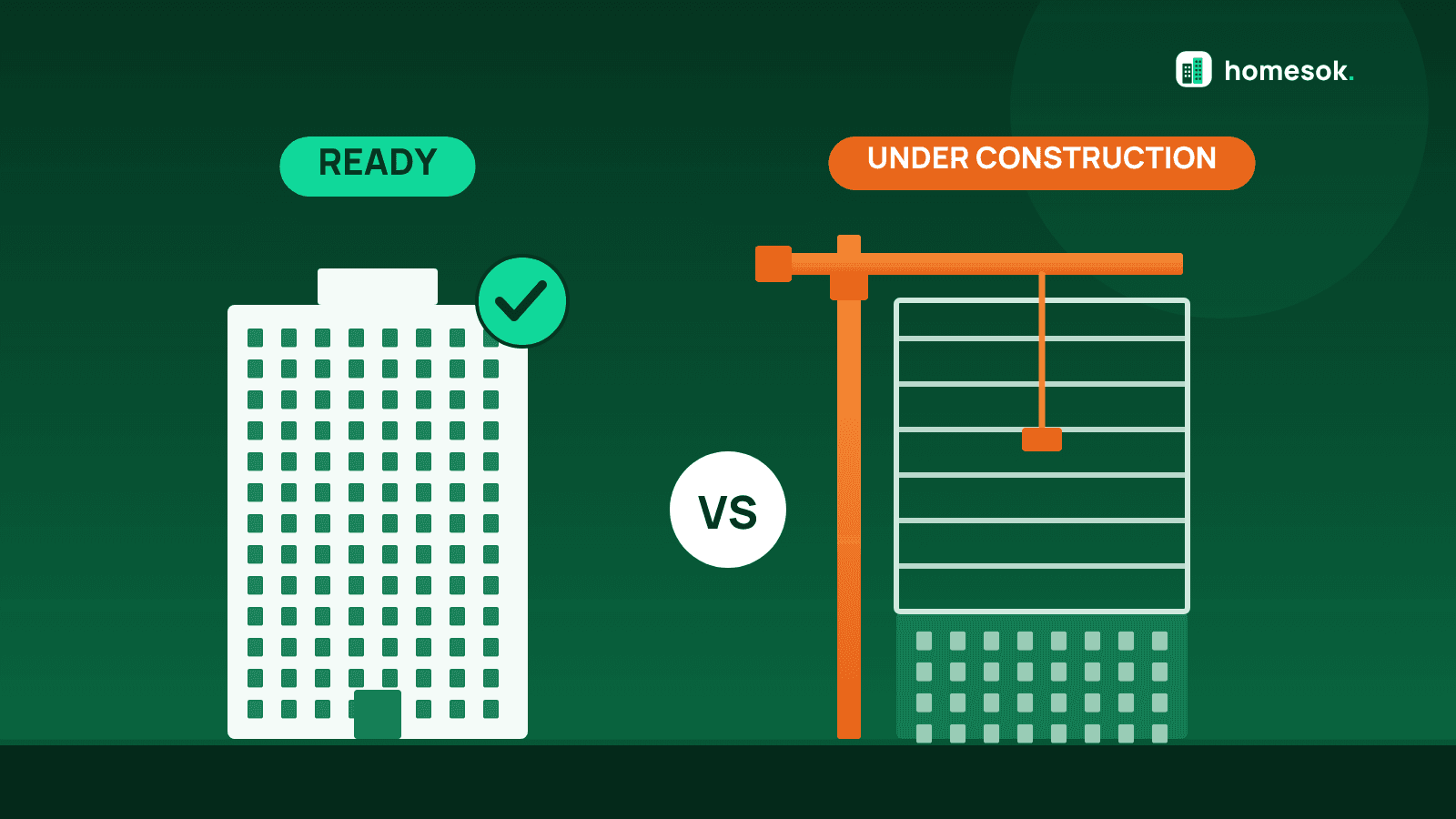
Ready-to-move (RTM) flats with an Occupancy Certificate carry zero GST and let you inspect the actual unit, but cost more. Under-construction (UC) flats are typically 15–20% cheaper and attract 5% GST (1% for affordable housing up to ₹45 lakh), but carry delay, quality and builder-solvency risk. RTM suits buyers who want certainty; UC suits buyers who want a lower entry price and can absorb risk.
Choosing between a ready-to-move flat and an under-construction one is, at its core, a trade between certainty and price. A ready-to-move (RTM) flat with an Occupancy Certificate carries zero GST and lets you inspect the exact unit you are buying, but you pay a premium for that certainty. An under-construction (UC) flat is typically 15–20% cheaper and may qualify for a 1% GST rate, but you take on delay, quality and builder-solvency risk, and you cannot see the finished unit before you commit. This comparison lays out the numbers and gives you clear decision rules for Bangalore.
The comparison at a glance
| Factor | Under Construction (UC) | Ready-to-Move (RTM) |
|---|---|---|
| Price | Typically 15–20% cheaper | Premium for completed, occupiable unit |
| Possession | Delayed (12 to 48 months typical) | Immediate |
| GST | 5% standard; 1% affordable housing | 0% on RTM with a valid OC |
| Risk | Delay, quality and builder-credibility risk | Minimal (the building exists) |
| Inspection | Sample flat / specifications only | Physical inspection of the actual unit |
Everything below expands these five rows with the current rules and real rupee numbers.
Price: why under-construction is 15–20% cheaper
The discount is not generosity; it is economics. When you buy under-construction, your construction-linked payments fund the build. In effect, the builder is financing the project partly from your money rather than borrowing the whole amount from a bank, and prices the flat lower to compensate you for waiting and for carrying the risk that the project slips or, in the worst case, stalls. A ready-to-move flat carries none of that risk for you; the building exists and is occupiable, so it commands a premium. The 15–20% gap is the market's price for certainty.
The catch is that the headline gap shrinks once tax enters the picture, which is the next row.
The GST impact: 5% on UC vs 0% on RTM
This is the single most underappreciated number in the comparison, so let's be precise. GST applies only to under-construction property, because the law treats an incomplete building as a construction service. The moment a project receives its Occupancy Certificate or Completion Certificate, it becomes immovable property under Schedule III of the CGST Act and attracts no GST at all.
The current rates, unchanged through the latest GST Council positions:
- 5% on under-construction standard (non-affordable) housing, without input tax credit.
- 1% on under-construction affordable housing: units priced up to ₹45 lakh with carpet area up to 60 sq m in metros, and Bengaluru is classified as a metro.
- 0% on ready-to-move flats backed by a valid OC.
GST is charged after deducting one-third of the value as deemed land cost. A worked example makes the difference concrete:
Take a ₹1 crore under-construction (non-affordable) flat. One-third (~₹33.3 lakh) is treated as land and is GST-exempt; GST at 5% applies to the remaining ~₹66.7 lakh, which is roughly ₹3.3 lakh of GST. The same flat bought ready-to-move with an OC attracts zero GST. That ₹3.3 lakh swing is real money, and it offsets a meaningful chunk of the 15–20% base-price advantage that under-construction started with.
So when you compare, never compare sticker prices. Add 5% (or 1%) GST to the UC flat, and add the rent you will keep paying during construction, before you decide which is genuinely cheaper.
Risk: delay, quality and builder solvency
The risk all sits on the under-construction side. The flat might be delivered late, built to a lower spec than promised, or, in the rare but ruinous case, never completed because the builder ran out of money. Your protection is RERA.
For a UC purchase, vet the project on the Karnataka RERA portal: registration number, sanctioned plans, committed completion date, and the quarterly progress reports the builder must file. RERA also requires 70% of buyer funds to be held in a project escrow account, caps the pre-agreement advance at 10% of the price, and imposes a five-year structural-defect liability on the builder, with defects to be repaired within 30 days.
If the builder misses the promised date, Section 18 gives you two options: withdraw and claim a full refund with interest, or stay and claim delay interest for every month late. The interest rate is SBI MCLR + 2%, roughly 11% per annum at recent MCLR levels. Karnataka RERA has enforced this in practice: in one Bengaluru case the authority ordered a builder to refund close to ₹33 lakh with interest at SBI MCLR + 2% after possession was not delivered, and in another imposed a penalty of up to 5% of project cost on a developer for ignoring its refund order. The protection is real, but enforcement can be slow, which is itself a reason to buy from a builder with a clean delivery record. A ready-to-move flat sidesteps all of this: there is no possession date to miss.
Possession timing and what it does to registration and Khata
For under-construction you typically sign a Sale Agreement first, with payments linked to construction milestones, and the Sale Deed is registered at possession. For ready-to-move, that gap collapses; you register quickly. The distinction matters legally, and it is worth reading our breakdown of the Sale Deed versus the Sale Agreement before you sign anything, because the document that protects you differs by stage.
Two cost notes that apply equally to both: stamp duty follows Karnataka's slabs and the registration fee is now 2% of property value (raised from 1% effective 31 August 2025). The base for stamp duty is the higher of your sale price or the area's guidance value, so check the guidance value on Kaveri before you budget. On the records side, a ready-to-move flat should already have its e-Khata in place via BBMP e-Aasthi; an under-construction flat's e-Khata and, critically, its Occupancy Certificate come only at completion.
Inspection rights: only RTM lets you see the real thing
With a ready-to-move flat you inspect the actual unit: the finishes, the water pressure, the ventilation, the light at different times of day, the lift, the common areas, the parking, and any deviations from the brochure. With under-construction you see a sample flat or a specification sheet, and you are buying a promise. That makes the specification schedule in your sale agreement and the carpet-area definition the things to scrutinise hardest, because they are all you are contractually guaranteed until handover. RERA's mandate to price on carpet area, not super built-up, helps, but read the schedule line by line.
When under-construction makes sense
- You want the lowest entry price and can absorb the 15–20% base discount being partly offset by 5% GST.
- You can wait 12–48 months without a punishing rent-plus-EMI overlap.
- You are buying from a RERA-registered builder with a strong on-time delivery record.
- You want payment spread across construction milestones rather than a lump sum.
- The unit qualifies as affordable housing (≤₹45 lakh, ≤60 sq m carpet), so you pay just 1% GST.
When ready-to-move makes sense
- You need to move in now and cannot carry rent and an EMI together.
- You want zero GST: a clean 0% on a flat with a valid OC.
- You want to inspect the exact unit and remove delivery and quality risk entirely.
- You value certainty over squeezing out the lowest possible price.
- You want immediate e-Khata and OC so the title is financeable and resaleable from day one.
Bangalore-specific factors
Locality deliverability records matter as much as the RTM-vs-UC question itself. Whitefield is the city's most consistent end-user and rental market, anchored by IT employment and a deep base of completed stock, a relatively lower-risk place to buy under-construction because demand and delivery are both established. Sarjapur Road offers higher growth potential but carries more construction-delay and congestion risk, so builder selection matters more there. North Bangalore (Devanahalli, Yelahanka, Bagalur) is riding airport-led and infrastructure-led growth, with plotted and apartment supply expanding; promising, but verify each project's approvals individually rather than relying on the corridor's momentum. Wherever you buy under-construction, the RERA record of the specific project beats any general sense of the locality.
Quick Reference
| Decision lens | Lean UC if… | Lean RTM if… |
|---|---|---|
| Budget | You want the lowest base price | You want zero GST and full certainty |
| Timeline | You can wait 12–48 months | You need to move in now |
| Risk appetite | You can absorb delay risk | You want minimal risk |
| Inspection | You trust the spec + RERA plans | You want to see the actual unit |
| Tax | Unit qualifies for 1% affordable rate | 0% GST on OC-backed flat matters most |
Need help with your Bangalore property?
Every property listed on Homesok comes pre-verified: legal title, RERA, OC, EC, and Khata all confirmed before listing. Buyers earn rewards after their sale agreement.
Frequently asked questions
Is ready-to-move cheaper than under-construction in Bangalore?+−
No. Ready-to-move is generally more expensive on the base price. Under-construction flats are typically 15–20% cheaper because the builder is funding construction with your staged payments and prices in the wait and the risk. However, the gap narrows once you account for GST: a ready-to-move flat with an Occupancy Certificate attracts zero GST, while an under-construction flat attracts 5% (1% for affordable housing). Build the full total (base price, GST, stamp duty, registration and rent paid during construction) before deciding which is actually cheaper.
What is the GST on ready-to-move vs under-construction property?+−
A ready-to-move flat with a valid Occupancy Certificate or Completion Certificate attracts 0% GST, because a completed property is treated as immovable property, not a construction service. An under-construction flat attracts 5% GST without input tax credit for standard housing, and 1% for affordable housing: units up to ₹45 lakh with carpet area up to 60 sq m in metros like Bengaluru. GST is charged after deducting one-third of the value as deemed land cost. Stamp duty and registration are separate and apply to both.
What is the RERA delay penalty if my under-construction flat is late?+−
Under Section 18 of RERA, if the builder misses the promised possession date you can either withdraw and claim a full refund with interest, or stay and claim interest for every month of delay. The interest rate is the State Bank of India's Marginal Cost of Lending Rate (MCLR) plus 2%, which works out to roughly 11% per annum at recent MCLR levels. File the complaint on the Karnataka RERA portal with your agreement, payment receipts and the promised possession date.
Does stamp duty differ between ready-to-move and under-construction?+−
No. Stamp duty is identical for both; it follows Karnataka's slabs: 2% for property valued below ₹20 lakh, 3% between ₹21 and ₹45 lakh, and 5% above ₹45 lakh, calculated on the higher of the sale value or guidance value. The registration fee is also the same for both, at 2% of property value (raised from 1% effective 31 August 2025). What differs is the GST and the timing of registration, not the stamp duty.
Can I inspect an under-construction flat before buying?+−
Not the actual unit. Only a ready-to-move flat lets you physically inspect the specific apartment you are buying, including finishes, water pressure, ventilation and the building as built. For under-construction you see a sample flat or a specification sheet, so the protection you have is contractual: scrutinise the specification schedule in the sale agreement, the carpet-area definition (RERA mandates carpet-area pricing), and the RERA-registered plans, because those are what you are actually promised.
Why is under-construction 15–20% cheaper than ready-to-move?+−
It is not purely a discount; it reflects the economics. When you buy under-construction, your staged payments fund the build, so the builder is effectively borrowing from you instead of a bank, and prices the flat lower to compensate you for the wait and the risk of delay or non-delivery. A ready-to-move flat carries none of that risk for you, so it commands a premium. The 15–20% gap is the market's price for certainty versus risk.
Is Bengaluru treated as a metro for affordable-housing GST?+−
Yes. For the 1% affordable-housing GST rate, the unit must be priced up to ₹45 lakh with a carpet area up to 60 sq m in metro cities, and Bengaluru is classified as a metro alongside Chennai, Delhi-NCR, Hyderabad, Kolkata and Mumbai MMR. In non-metros the carpet-area limit is 90 sq m. If your under-construction flat meets both the price and carpet-area caps, you pay 1% instead of 5%.
How do I check an under-construction builder's credibility?+−
Look the project up on the Karnataka RERA portal (rera.karnataka.gov.in). Verify the registration number, the sanctioned plans, the committed completion date, and the quarterly progress reports the builder is required to file. RERA also requires 70% of buyer funds to be kept in a project escrow account, and imposes a five-year structural-defect liability on the builder. A clean record plus a history of delivering past projects on time is the strongest signal; an unregistered project is a red flag.
Does a ready-to-move flat have an e-Khata and OC already?+−
It should. A genuine ready-to-move flat with possession will typically have its Occupancy Certificate and e-Khata in place; confirm both before buying, because they make possession lawful and the property financeable and resaleable. An under-construction flat will not have an OC (it cannot until completion) and its e-Khata follows later. So for ready-to-move, verify the OC and e-Khata; for under-construction, rely on RERA registration and the agreement.