DC Conversion in Bangalore: Process, Fees & Plot Buyer Guide 2026
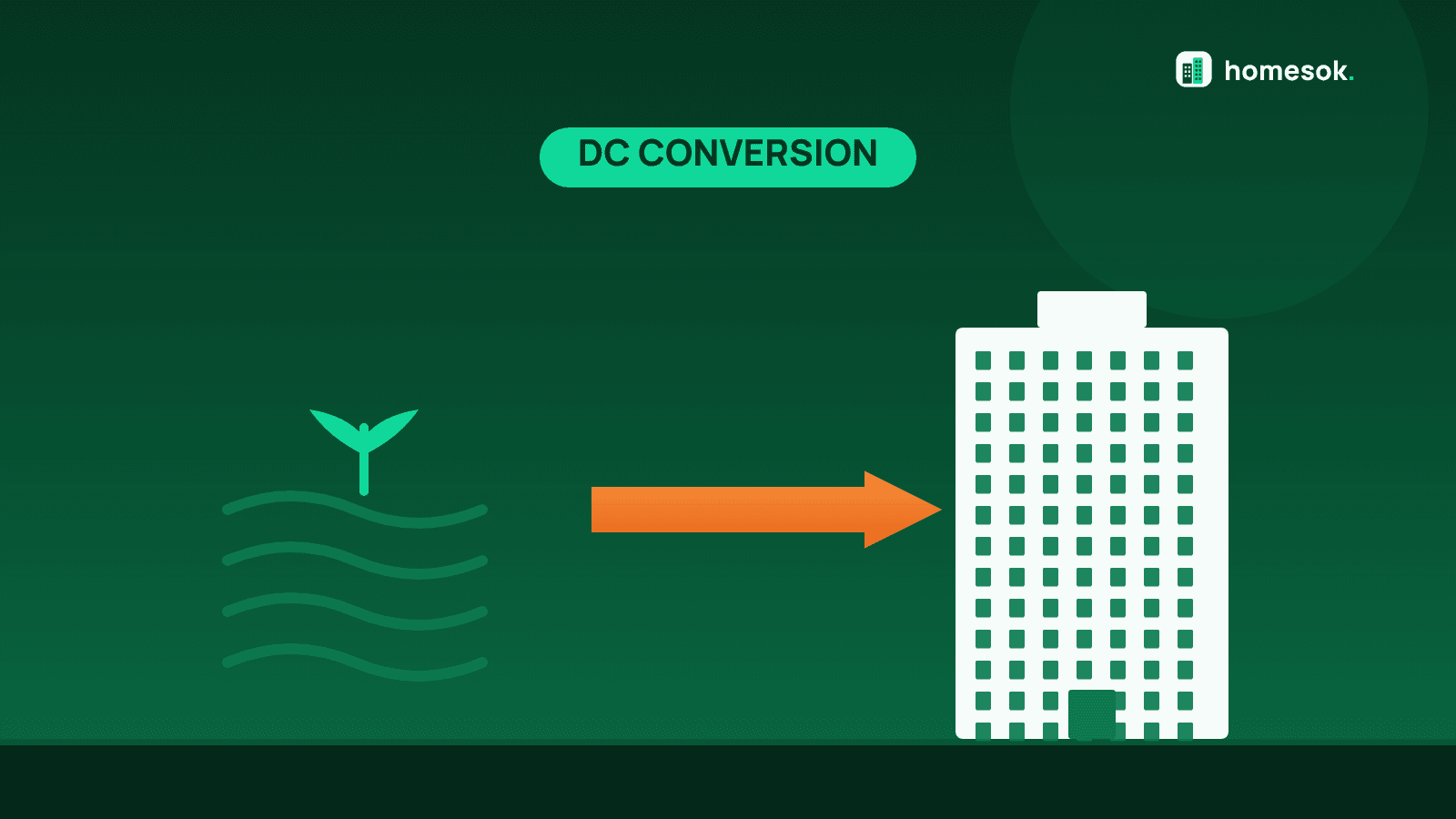
DC Conversion is the Deputy Commissioner's order, under Section 95 of the Karnataka Land Revenue Act, that legally changes land use from agricultural to non-agricultural. Without it, a plot in Bangalore's outskirts cannot get an A-Khata, a building plan, bank finance or utility connections. Apply at landconversion.karnataka.gov.in, and always verify the order in the RTC and encumbrance certificate before buying.
If you are buying a plot anywhere on Bangalore's edge (Devanahalli, Sarjapur, the Whitefield outskirts, the Kanakapura belt), DC conversion is the one legal fact that decides whether you are buying a buildable residential plot or a piece of farmland with a nice signboard. DC Conversion is the Deputy Commissioner's order, issued under Section 95 of the Karnataka Land Revenue Act, that legally changes land use from agricultural to non-agricultural. Without it, the plot cannot get an A-Khata, a building plan, a bank loan or a permanent utility connection, no matter what the brochure says. This guide explains the process, the fees, and, above all, how to verify a conversion before you pay.
What DC conversion is
Every parcel of land in Karnataka is, by default, classified as agricultural. Until something changes that classification, the land is legally meant for farming and nothing else. DC conversion (formally "land conversion" or "change of land use") is the legal process that changes that classification to non-agricultural: residential, commercial or industrial. The name comes from the approving authority: the Deputy Commissioner of the Revenue Department, who grants the conversion under Section 95 of the Karnataka Land Revenue Act, 1964.
The reason this exists is that agricultural land in Karnataka carries specific legal protections: restrictions on who can buy it, obligations to cultivate it, and Land Reforms Act limits on transfer to non-agriculturists. Conversion lifts those for the approved non-agricultural purpose, but only that purpose: land converted for residential use cannot then be used commercially, and vice versa.
When you need it
You need DC conversion whenever the land you are buying or building on is recorded as agricultural and you intend to use it for a home, a plotted layout, or any non-agricultural purpose. In Bangalore's peri-urban belt this is the rule, not the exception, because the city expanded outward over what was farmland. Even within Bangalore's broader limits, many plots are still recorded as agricultural, and you must confirm conversion before you can lawfully build.
The consequence of skipping it is severe. Constructing on agricultural land without conversion violates Section 95: the DC can issue a notice, impose a penalty, and order demolition of the structure. The property will not get an Occupancy Certificate, cannot be registered as residential through the Sub-Registrar, and no bank will finance it.
Who issues it and where to apply
The Deputy Commissioner of the Revenue Department issues the conversion order. Applications are made online through the State's land conversion portal at landconversion.karnataka.gov.in, integrated with the Bhoomi land-records system and the Sakala service-guarantee framework. The old process required more than 20 documents submitted across multiple departments and took six months to a year; the current affidavit-based route cut the document load and the time substantially. You can choose, where applicable, between an affidavit-based conversion and a master-plan-based deemed conversion for land that already conforms to the published plan.
Documents required
- Prescribed application form under the Karnataka Land Revenue Rules (the Section 95 form).
- Current RTC (Record of Rights, Tenancy and Crops) from the Bhoomi portal.
- Survey / FMB sketch of the survey number from the Survey Department.
- Encumbrance Certificate from Kaveri (13 years minimum, 30 recommended).
- Registered Sale Deed confirming ownership.
- Mutation record.
- NOCs where required, from the Agriculture, Forest, Water Resources or Highways departments, and the local gram panchayat, depending on the land's location and surroundings. Once the conversion order is issued, the plot's panchayat record moves onto e-Swathu Form 9, the document the sub-registrar needs before any sale.
Step-by-step process
Confirm convertibility first by pulling the RTC and checking the Master Plan zoning: land marked Green Belt, Agriculture Protection Zone, Forest or Water Body Buffer cannot be converted regardless of any application. Then file online with the documents above, selecting the appropriate route. The DC's office verifies records, zoning and revenue status and inspects the site; concerned departments are asked for their opinion, and if they do not respond within the prescribed window, no-objection is presumed in some categories. On clearance you pay the fee and download the order, which you then notarise. Critically, conversion is the first step: you still need layout approval, the individual plot formed under that layout, a Khata, and a building-plan sanction before you can build. If construction does not begin within the prescribed period, the authority can withdraw the certificate.
Current fees: what it actually costs
This is where buyers get conflicting numbers, so let's be precise. There are two fee bases, which is the source of most of the confusion.
| Basis | What it is | Indicative figures |
|---|---|---|
| Legacy statutory rate (area-based) | A fixed rupee rate per cent of land (1 cent = 1/100 acre ≈ 40.47 sq m), by purpose and location | Residential: ₹327 per cent within 12 km of City Corporation; ₹218 Taluk Centre; ₹89 rural. Commercial: ₹654 / ₹327 / ₹218 |
| Operative practice (percentage of guidance value) | In master-plan/BBMP areas, charged as a % of guideline value | Commonly cited at ~1–2% for residential |
| Practitioner budgeting band | Real-world all-in estimate near Bangalore | ₹2–6 lakh per acre depending on guidance value and location |
| Stamp duty on the order | Fixed/nominal, separate from sale-deed stamp duty | Nominal fixed amount |
The honest takeaway: the ₹327 figure is a legacy statutory rate per cent of land (not ₹327 per plot and not ₹327 per square metre) and is widely treated as superseded in practice by the percentage-of-guidance-value approach in master-plan and BBMP areas. Because the basis genuinely varies by route and district, the only safe move is to confirm the current payable amount with the relevant Deputy Commissioner's office before you file. Budget for the higher end, and remember that conversion fees are only one slice of the 10–15% in additional costs (stamp duty, registration, Khata) that sit on top of the land price.
Typical timeline
Under the Karnataka Public Service Guarantee Act, the official Bhoomi portal cites a 120-day timeline; the Sakala framework is often cited at 60 days by secondary sources. In practice budget 60-120 days for a non-contested application, with the longer end more realistic for files needing inspection or document corrections. An affidavit-based fast-track exists for land conforming to the Master Plan, intended to be far quicker. In practice, secondary sources report 30 to 90 days for clean cases, with delays where documents are incomplete, zoning conflicts, or a site inspection is required.
How to verify DC conversion BEFORE buying a plot
This is the section to read twice. The most expensive mistakes in Bangalore's plot market come from skipping verification:
- Pull the current RTC from the Bhoomi portal and confirm the land status. A genuinely converted plot's records should reflect the conversion.
- Get the actual DC Conversion Order (not a photocopy the seller waves at you) and confirm it covers the entire survey number, has not lapsed, and matches the plot you are buying.
- Run an encumbrance certificate on Kaveri to confirm clean title and that the conversion shows in the records. This same EC check is the foundation of any plot due diligence.
- Check the Master Plan zoning to ensure the land is not in a non-convertible zone.
- Confirm layout approval and Khata exist. A conversion order alone does not make a plot buildable.
Red flags: the scams to call out
Bangalore's outskirts are full of traps for the under-informed buyer:
- Agricultural land sold as "residential." The land is still farmland in the records; the "residential" label is marketing. Without conversion it is illegal to build, un-financeable, and exposed to demolition.
- Forged, partial or lapsed conversion orders. Some plots have a conversion order for only a portion of the survey number; some orders have lapsed because construction never started in time. Verify the order itself, every time.
- The B-Khata trap on DC plots. A plot sold as "convertible" or "soon-to-be A-Khata" with only a B-Khata is a warning sign; understand exactly what a B-Khata means versus an A-Khata before you accept that story.
- Projects claiming DC conversion but no layout approval. Conversion without an approved layout still leaves you unable to form and register a legal plot.
The legal stack a plot buyer needs
Think of a clean Bangalore plot as a stack, each layer resting on the one below:
- DC Conversion: agricultural to non-agricultural (the foundation).
- Layout approval: from the planning authority (BBMP, BDA, BMRDA).
- A-Khata: issued by the local body once converted and approved. Unconverted land cannot get a city Khata at all, which is why DC conversion sits at the base. The relationship between A-Khata and B-Khata only makes sense once the land is converted.
- e-Khata: the digital record over the A-Khata, now mandatory for plan approvals and transactions, issued through BBMP e-Aasthi.
Miss the bottom layer and everything above it is invalid. DC conversion is not paperwork to defer; it is the legal basis on which a buildable, financeable, resaleable plot rests.
Quick Reference
| Item | Detail |
|---|---|
| What it does | Changes land use agricultural → non-agricultural |
| Legal basis | Section 95, Karnataka Land Revenue Act, 1964 |
| Who issues | Deputy Commissioner (Revenue Department) |
| Where to apply | landconversion.karnataka.gov.in |
| Fee basis | Legacy area-based (₹327/cent residential, 12 km City Corp) OR % of guidance value (~1–2%) in master-plan areas |
| PSG / Sakala timeline | 60-120 days non-contested (Bhoomi portal cites 120 under the Public Service Guarantee Act; secondary sources often cite 60 as the Sakala figure); affidavit fast-track for master-plan land |
| Verify via | RTC (Bhoomi), the conversion order itself, EC (Kaveri), Master Plan zoning |
| The stack | DC conversion → layout approval → A-Khata → e-Khata |
Note: The "₹327 residential per unit" figure from prior research has been clarified: it is ₹327 per CENT of land (1 cent = 1/100 acre ≈ 40.47 sq m), a legacy statutory rate, not ₹327 per plot or per square metre, per architects4design.com and 99acres.com. The current operative basis in master-plan/BBMP areas is widely applied as a percentage of guidance value (~1–2% residential). The official fee table at landconversion.karnataka.gov.in should be checked directly in a browser to confirm the exact current rate for a specific plot, as the portal blocks automated access.
Need help with your Bangalore property?
Every property listed on Homesok comes pre-verified: legal title, RERA, OC, EC, and Khata all confirmed before listing. Buyers earn rewards after their sale agreement.
Frequently asked questions
What is the cost of DC conversion in Bangalore?+−
There are two fee bases. The legacy statutory rate is area-based: for residential conversion it is about ₹327 per cent of land (one cent is 1/100 acre, roughly 40.47 sq m) within 12 km of the City Corporation limit, ₹218 at a Taluk Centre and ₹89 in rural areas. In master-plan and BBMP areas the operative charge is widely applied as a percentage of the guidance value, commonly cited at 1–2% for residential. Practitioner budgeting ranges run ₹2–6 lakh per acre near Bangalore. A nominal fixed stamp duty also applies to the order. Confirm the exact current rate with the relevant Deputy Commissioner's office before filing.
Is DC converted land safe to buy?+−
It is far safer than unconverted land, but only if the conversion is genuine and complete. Verify the DC Conversion Order is authentic, covers the entire survey number (not a portion), has not lapsed, and that the post-conversion conditions were satisfied. Cross-check the order in the RTC and the encumbrance certificate, and confirm layout approval and Khata. Many buyers have lost money on plots sold as 'converted' where the order was forged, partial or lapsed, so verify the order itself, do not take the seller's word.
How do I get a DC conversion certificate?+−
Apply to the Deputy Commissioner of the district under Section 95 of the Karnataka Land Revenue Act, through the online portal at landconversion.karnataka.gov.in or the Bhoomi land-conversion route. Submit the prescribed form, RTC, survey sketch, encumbrance certificate, sale deed, mutation record and required NOCs. The DC office verifies records and zoning, inspects the site, and on clearance you pay the conversion fee and download the order. Under the Karnataka Public Service Guarantee Act, the official Bhoomi portal cites a 120-day timeline for non-contested applications, with the Sakala framework often cited at 60 days by secondary sources; budget 60-120 days in practice; an affidavit-based fast-track exists for master-plan-conforming land. For Bengaluru properties, verify the order downstream against the RTC and Encumbrance Certificate before treating the conversion as final.
What is DC in BBMP / what does DC conversion mean?+−
DC stands for Deputy Commissioner (of the Revenue Department), the authority who approves land-use conversion. DC conversion is the legal process of changing land use from agricultural to non-agricultural (residential, commercial or industrial) under Section 95 of the Karnataka Land Revenue Act, 1964. Every parcel of land in Karnataka starts out classified as agricultural; without DC conversion it legally remains farmland, even if buildings stand on it, and cannot get a city Khata or building approval.
Can DC-converted land get an A-Khata?+−
Yes, and this is the key link for plot buyers. Once land is DC-converted to non-agricultural use, it becomes eligible for an A-Khata from the local body, provided the layout is approved and the other compliance conditions are met. Unconverted agricultural land cannot get a city Khata at all. So a clean legal plot in Bangalore's outskirts needs the full stack: DC conversion, then layout approval, then A-Khata, then e-Khata. Missing the DC conversion at the bottom of that stack invalidates everything above it.
How long does DC conversion take in Karnataka?+−
Under the Karnataka Public Service Guarantee Act, the official Bhoomi portal cites a 120-day timeline; the Sakala framework is often cited at 60 days by secondary sources. In practice budget 60-120 days for a non-contested application, with the longer end more realistic for files needing inspection or document corrections. An affidavit-based route exists for land that conforms to the published Master Plan, intended to be much faster. Secondary sources still report 30 to 90 days for straightforward cases; practical timelines in Bengaluru can stretch longer where records need correction.
What happens if you build on agricultural land without DC conversion?+−
Constructing on agricultural land without DC conversion violates Section 95 of the Karnataka Land Revenue Act. The Deputy Commissioner can issue a notice, impose a penalty, and order demolition of any structure built without conversion. The property will not receive an Occupancy Certificate, cannot be registered as a residential property through the Sub-Registrar, and no bank will finance it. The deficiency will also surface in the encumbrance certificate during any future title check.
What documents are needed for DC conversion?+−
The core set is the prescribed application form under the Karnataka Land Revenue Rules, the current RTC (from the Bhoomi portal), the survey/FMB sketch from the Survey Department, an encumbrance certificate from Kaveri (13 years minimum, 30 recommended), the registered sale deed proving ownership, the mutation record, and NOCs where required, from the Agriculture, Forest, Water Resources or Highways departments and the local gram panchayat. The affidavit-based route reduced the document load substantially compared with the older process.
How do I verify DC conversion before buying a plot?+−
Pull the current RTC from the Bhoomi portal and confirm the land status; a genuinely converted plot's status should reflect the conversion. Obtain the actual DC Conversion Order and check it covers the full survey number, has not lapsed, and matches the plot. Run an encumbrance certificate on Kaveri to confirm clean title and that the conversion shows in the records. Check the Master Plan zoning. And confirm there is layout approval and a Khata; a conversion order alone does not make a plot buildable.
- Karnataka Land Conversion Portal (Revenue Department)
- Karnataka Bhoomi Land Records Portal
- Kaveri Online Services · Encumbrance Certificate
- Architects4Design · DC Conversion in Bangalore: Charges & Documents
- 99acres · How to apply for land conversion (CLU) in Karnataka
- Square Yards · DC converted land in Bangalore