A Khata vs B Khata in Bangalore: Differences, Risks & Conversion 2026
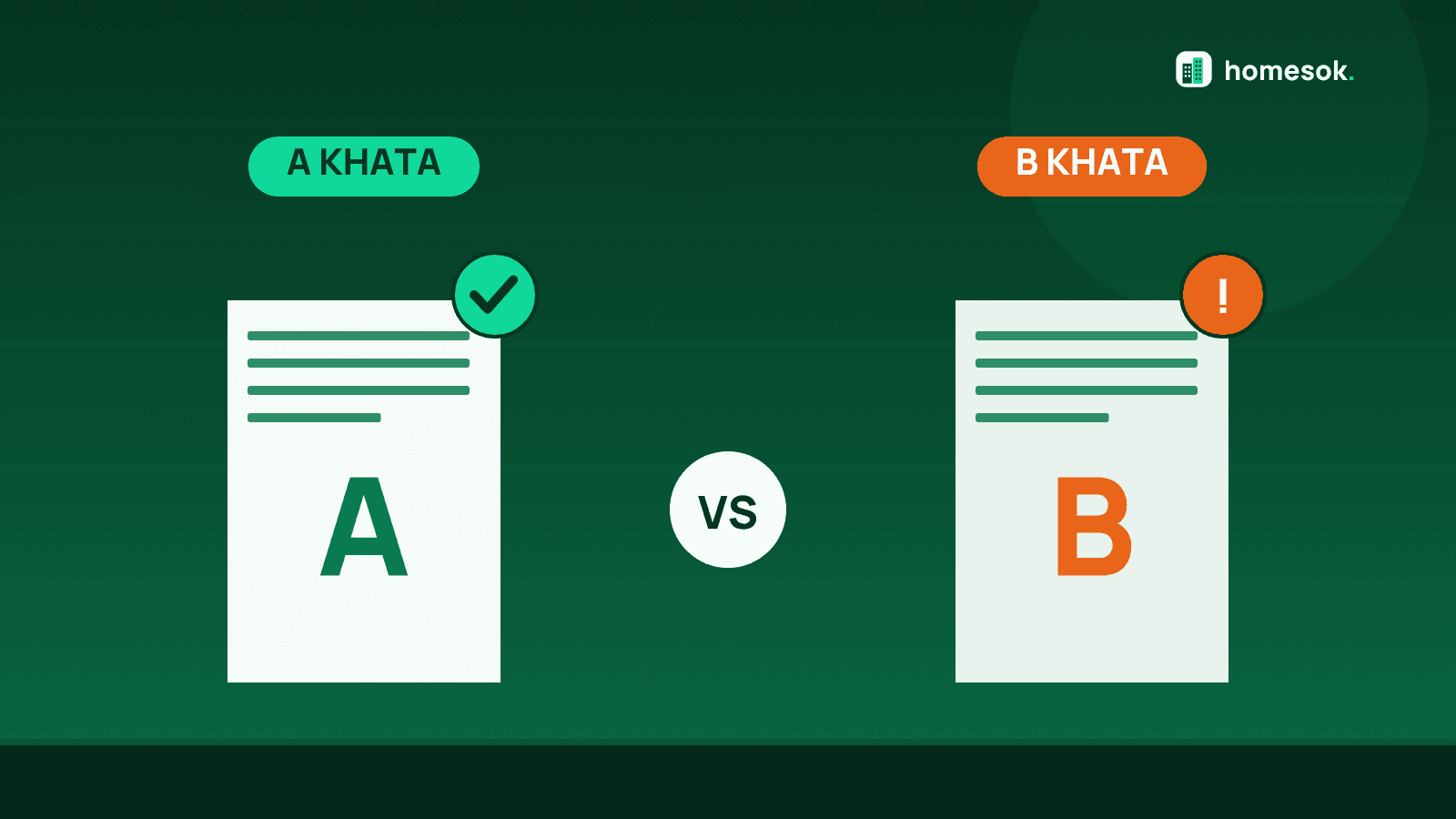
A-Khata means a property fully compliant with BBMP/GBA rules: loanable, plan-sanctionable and freely resaleable. B-Khata is a separate tax register for properties with irregularities; you pay tax but the legal rights are limited. e-Khata is the digital layer over both, and a B-Khata property's e-Khata is still a B-Khata. Conversion from B to A is the only way to remove the limitation.
If you are buying property in Bangalore, "A-Khata" and "B-Khata" are two of the first terms you will trip over, and the honest difference matters more than most listing agents will tell you. Put simply: an A-Khata means your property is legally recognised by BBMP/GBA as fully compliant, while a B-Khata means it sits in a separate tax register for properties with irregularities. You pay tax on both, but the rights attached to them are not the same. And layered over both is e-Khata, the new digital record, which is where a lot of buyers now get confused, because an e-Khata on a B-Khata property is still a B-Khata.
The one-paragraph version
A-Khata = the property is on BBMP/GBA's main register, fully compliant, loanable, plan-sanctionable and freely resaleable. B-Khata = the property is on the "B register," a separate tax ledger introduced in 2007 for properties that do not fully comply with municipal norms: unapproved layouts, plan deviations, or land on revenue/unconverted holdings. You can pay tax on a B-Khata property, but you cannot easily borrow against it, sanction a plan on it, or sell it without a discount. e-Khata is the digital version of whichever record you already hold; it modernises access but does not upgrade your legal status. About 7 lakh properties in Bengaluru sit in the B register, according to Advocate Praneeth Kumar P of PKP Advocates, so this is not a fringe problem.
What is an A-Khata
An A-Khata is the official BBMP/GBA revenue record for a property that meets all municipal and planning requirements: the land use is correct (and DC-converted where the land was originally agricultural), the layout is approved, the building conforms to the sanctioned plan, and property tax is current. The Khata certificate of an A-Khata property explicitly states it is issued under the Karnataka Municipal Corporations Act, 1976.
The practical value of an A-Khata is the rights bundle that comes with it. Banks lend against it without hesitation. You can sanction or extend a building plan. Obtaining an Occupancy Certificate is possible. And resale is clean: buyers and their lenders accept it without the haircut a B-Khata invites. A-Khata properties also convert directly to e-Khata without additional compliance steps, which is a real advantage in the current digital-first regime.
What is a B-Khata
A B-Khata is not a different kind of ownership; it is a different register. BBMP created the "B register" in 2007 under its Revenue Rules to collect property tax from properties that did not fully comply with its norms. The owner pays tax and gets a receipt, but the property does not carry the full legal recognition of an A-Khata.
Properties land in the B register for three common reasons: they sit in revenue layouts sub-divided without planning-authority approval (outside city limits, the same distinction plays out as e-Swathu Form 9 versus Form 11B); they have construction that deviates from the sanctioned plan (excess FAR, inadequate setbacks, unauthorised floors); or they were in areas absorbed into BBMP through the city's expansion where the underlying regularisation was never completed. A single property can be B-Khata for more than one of these reasons at once, and a revenue-layout site that also has an unsanctioned addition is in a harder position than one that only lacks layout approval.
The restrictions are the whole point: limited lending, restricted plan sanction, difficulty getting an OC, and a resale discount the market refuses to ignore. The limitation does not go away on its own; it compounds over time. Conversion to A-Khata is the only way to remove it.
A vs B vs e-Khata: the three-way comparison
| Dimension | A-Khata | B-Khata | e-Khata |
|---|---|---|---|
| Legal status | Fully compliant, on main register | On "B register"; irregularities/limited recognition | Digital layer over A or B: reflects, doesn't change, status |
| Property tax | Levied and accepted | Levied and accepted | Same tax record, digitised |
| Building plan rights | Can sanction/extend plans | Restricted until regularised | Mandatory for plan approval since July 2025 |
| Bank lending | Standard home loans available | Most banks decline | Helps verification; loan still depends on A-status |
| Resale ease | Clean, no discount | Harder, market discount | Easier access to records; status unchanged |
| Conversion path | Already compliant | Convert to A via BBMP B-to-A portal | Not a status; issued on top of A or B |
The single most important line in this table: e-Khata is not a status. It is the format. An e-Khata issued on a B-Khata property states "B" on its face, and that determines whether the property is loanable, plan-sanctionable and fully resaleable. If you understand nothing else, understand that getting an e-Khata via BBMP e-Aasthi does not upgrade a B-Khata.
How to check whether your Khata is A or B
Three quick checks. First, read your Khata certificate and extract: an A-Khata says so, citing the KMC Act, 1976. Second, look up the property on the BBMP/GBA e-Aasthi portal using your PID/ePID or owner name; the e-Khata states the register. Third, if in doubt, ask at the Assistant Revenue Officer (ARO) office. Do not rely on the registered sale deed to tell you: a property can have a perfectly valid sale deed and still be B-Khata, because the Khata is a municipal record, not a title document.
Is B-Khata safe to buy?
The honest answer most agents won't give: technically you can buy one, but it carries risk. Before you consider a B-Khata property, run four questions:
- Is it eligible for conversion to A-Khata under the current scheme?
- Is the underlying land DC-converted? If it is still agricultural/revenue land, conversion may fail outright. For B-Khata properties on the city's outskirts, also verify the underlying DC conversion order before assuming the land is legally non-agricultural.
- Is the title clean? Pull the encumbrance certificate on Kaveri to confirm there are no undisclosed loans, liens or disputes; this is non-negotiable on a B-Khata buy.
- Can you fund it without a standard home loan? Most banks decline B-Khata, so assume cash or a higher-cost lender until conversion is done.
A B-Khata can work for a buyer who understands exactly what they are buying, has verified eligibility for conversion, and has priced the conversion cost and risk into the deal. It is dangerous for a buyer who assumes "B-Khata is basically the same"; it is not.
How to convert B-Khata to A-Khata
Karnataka moved this online. BBMP/GBA launched a dedicated B-to-A conversion portal at bbmp.karnataka.gov.in/BtoAKhata in late 2025, and the process now runs largely digitally for plots up to 2,000 sq m (larger plots go through an enrolled architect/engineer).
The route: confirm your B-Khata category, clear tax dues, secure a DC Conversion Order if the land was agricultural, obtain a final verified e-Khata, then file the conversion request with your sale deed, tax receipts, EC, building-plan sketch, single-plot plan and DC order. BBMP scrutinises the documents and inspects the site. A recurring snag is survey-number mismatches between the sale deed and the BBMP system (common in East and South Bangalore where 1970s–80s survey records were re-surveyed in the 2000s), which can require a fresh survey before the file clears. The transfer mechanics overlap heavily with an ordinary Khata transfer on e-Aasthi, so it is worth understanding both together.
The cost of conversion
The headline charge is the conversion fee, calculated as a percentage of the property's guideline (guidance) value. The standard rate is 5%, plus a ₹500 application fee and applicable betterment and processing charges.
During a special 100-day window from 15 May 2026 to 23 August 2026, under the State's "Namma Khate, Namma Hakku" / Bhu Guarantee regularisation drive, the rate was cut to 2% of guideline value, and from 24 August 2026 it reverts to 5%. On a property with a ₹50 lakh guidance value, that is the difference between roughly ₹1 lakh (at 2%) and ₹2.5 lakh (at 5%). For an owner sitting on a convertible B-Khata, a discounted window like this is the cheapest moment to act, though you should always verify the live payable amount inside the BBMP workflow, since betterment charges vary by zone and property status.
Alongside the fee cut, the State raised the building-violation limit for legal utility connections from 5% to 15%, aligned with Supreme Court guidance, meaning minor deviations now qualify for regular electricity and water connections.
Lending and resale implications
For lending, the line is bright: A-Khata gets standard home loans; B-Khata usually does not. That single fact drives most conversions, because a property you cannot finance is a property most buyers cannot purchase, which feeds the resale discount. On resale, an A-Khata sells at full market value to a buyer who can get a loan; a B-Khata sells slower, to a narrower pool, at a discount. Converting before you sell typically pays for itself in the price you recover.
Quick Reference
| Item | A-Khata | B-Khata |
|---|---|---|
| Register | Main BBMP/GBA register | Separate "B register" |
| Home loan | Yes | Usually no |
| Building plan sanction | Yes | Restricted |
| Resale | Clean, full value | Discounted, slower |
| e-Khata eligible | Yes (direct) | Yes, but stays B |
| Conversion fee | N/A | 5% of guidance value (2% during 15 May–23 Aug 2026 window) + ₹500 |
| Conversion portal | – | bbmp.karnataka.gov.in/BtoAKhata |
| Timeline | – | ~30–45 days for clean cases |
Need help with your Bangalore property?
Every property listed on Homesok comes pre-verified: legal title, RERA, OC, EC, and Khata all confirmed before listing. Buyers earn rewards after their sale agreement.
Frequently asked questions
Which is better, A-Khata or B-Khata?+−
A-Khata is unambiguously better. An A-Khata property is recognised by BBMP/GBA as fully compliant: you can get a home loan against it, sanction or extend a building plan, and resell it without the discount the market applies to B-Khata. A B-Khata property is taxed like any other but its legal rights are limited: lending is difficult, plan sanction is restricted, and resale is harder. If you have a genuine choice between two properties, the A-Khata one carries materially less risk.
Is B-Khata safe to buy?+−
Buying a B-Khata property is not illegal, but it carries real financial and legal risk that most buyers underestimate. Before considering one, ask: is the property eligible for B-to-A conversion, is the underlying land DC-converted, is the title clean on the encumbrance certificate, and can you fund it without a standard home loan (since most banks decline B-Khata)? If the answer to any of these is no, treat it as a high-risk purchase. A B-Khata flat in an apartment complex is especially difficult because flat owners often cannot apply for conversion individually.
Can we convert B-Khata to A-Khata?+−
Yes. BBMP/GBA runs an online B-to-A conversion process at bbmp.karnataka.gov.in/BtoAKhata, launched as a dedicated portal in late 2025. Eligible properties pay a conversion charge calculated as a percentage of guidance value plus a ₹500 application fee and applicable betterment charges. Previously agricultural land needs a valid DC Conversion Order first, and buildings with significant unauthorised construction need plan regularisation before a full A-Khata is possible. Straightforward cases take roughly 30 to 45 days.
How do I know if my Khata is A or B?+−
Check your Khata certificate and Khata extract: an A-Khata explicitly mentions it is issued under the KMC Act, 1976. You can also look up the property on the BBMP/GBA e-Aasthi portal, or ask at the Assistant Revenue Officer (ARO) office. Importantly, your e-Khata certificate itself states the register, A or B, so once you have pulled the e-Khata you can read the status directly. Do not assume a registered sale deed alone tells you the Khata type; it does not.
How much does B-to-A Khata conversion cost in 2026?+−
The standard conversion charge is 5% of the property's guideline (guidance) value, plus a ₹500 application fee and applicable betterment and processing charges. During a special 100-day window from 15 May 2026 to 23 August 2026 under the 'Namma Khate, Namma Hakku' / Bhu Guarantee drive, the rate was reduced to 2% of guideline value; from 24 August 2026 it reverts to 5%. On a property with a ₹50 lakh guidance value, the 5% charge is roughly ₹2.5 lakh. Confirm the live payable amount inside the BBMP workflow before paying.
Can a B-Khata property get an e-Khata?+−
Yes. Both A-Khata and B-Khata properties are eligible for e-Khata, because e-Khata only digitises the existing record. Crucially, it does not convert a B-Khata into an A-Khata and does not remove the approval and loan-related limitations. Several owners have received their e-Khata and wrongly assumed their B-Khata status was resolved; it was not. The e-Khata states the register, and that A-or-B character is what banks and buyers look at.
Do banks give home loans on B-Khata properties?+−
Generally no. Most nationalised banks and major private lenders decline home loans against B-Khata properties because they are treated as legally non-compliant. This is one of the main reasons owners convert to A-Khata: once conversion is complete, standard home-loan financing opens up. Some smaller or non-banking lenders may finance B-Khata at higher rates, but you should not assume mainstream loan access on a B-Khata purchase.
What does the 15% deviation relaxation mean for B-Khata owners?+−
Alongside the conversion-fee reduction, the State raised the building-violation limit for legal electricity and water connections from 5% to 15%, aligned with Supreme Court guidance. This means buildings with minor deviations from the approved plan (a marginally extended balcony, a small floor-area increase) that fall within 15% can now qualify for regular utility connections. It does not regularise major violations, but it relieves many families who were stuck without legal connections over technical deviations.